
My 4th great grandfather, William “Honest Billy” Shaw, by his own account, grew up in Wythe County in southwest Virginia, “on the waters of the New River.”
Virginia origins
I am virtually certain that William’s father was another William Shaw who is found in local records from that time. By digging into that William Shaw’s neighbors and associates, I was able to determine that by 1777, the older William Shaw was living just south of Wytheville on Reed Creek, a tributary of the New River. He may have migrated there, along with some other families, from around Salem, Virginia. I am still looking into that possibility. (Note that the ever-accurate William Junior, born in 1761, does not state that he was born in Wythe County in his pension application. Rather, he states that he was “raised principally” in Wythe county, implying that he moved there as a child.)

William Shaw Senior is found on the 1782 tax list for Montgomery County, in the area that later became Wythe County. He shows two “tithes” or men over the age of 21, which matches up perfectly with William Junior, who was born in 1761, turning 21 in that year. Meanwhile, in the previous year, 1781, the younger William Shaw is found on militia lists for the same county. As he only needed to be 16 to serve in the military, he shows up on these lists before he was an adult for tax purposes. All of this makes sense.
William Shaw Senior did not leave much of a paper trail otherwise, but I am hopeful that with more research into his FAN club, I will be able to learn more about him and further confirm that he is my 5th great grandfather.
William heads west to Tennessee
By July of 1785, the younger William Shaw had moved to Davidson County, Tennessee, where court records note that he served on a jury. This is the first mention I found of him in Tennessee records. In his 1832 pension application, he states that he has lived in Davidson county for “upwards of forty-six years.” Doing the math, Honest Billy nailed it again. He arrived by 1785, when he was about 24 years old.
In 1788, William bought 130 acres for 100 pounds from Absolom and Elizabeth Hooper. The property was on Whites Creek, which runs just north of Nashville. At that time, there was also a settlement called Whites Creek. It is now a suburb of Nashville with a historic district.
Now we’re in business
In October, 1789, court records show that William took on an orphaned boy named James Vernon as his apprentice.
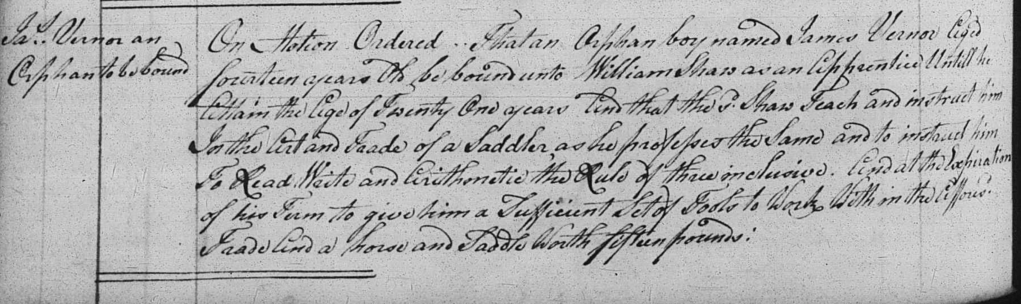
On Motion Ordered, That an Orphan Boy named James Vernon Aged fourteen years be bound unto William Shaw as an Apprentice Until he Obtain the Age of Twenty One years and that the sd Shaw Teach and instruct him in the Art and Trade of a Saddler as he professes the Same and to instruct him to Read, Write and Arithmetic the Rule of Three Inclusive. And at the Expiration of his Term to give him a Sufficient Set of Tools to Work With in the Aforesd Trade and a horse and Saddle with fifteen pounds.
Now we know that William was a “Saddler” by trade! This makes perfect sense. The area of southwest Virginia that he came from was mountain country, dotted by coal mines and pig iron furnaces. There were no railroads yet, so horse-drawn carts carried everything. There would have been great demand for both blacksmiths and saddlers to support these industries.

William Shaw Senior owned very little land, yet we know he was literate from his son’s pension application–and can infer as much from the fact that William Junior was considered by the court to be capable of teaching reading, writing and arithmetic. The Shaws also lived on the edge of a town, sandwiched between larger landowners. And William Junior could afford to buy his own, apparently rather valuable, land by the time he was 27, so he clearly wasn’t poor. It seems very likely that William Senior was a saddler, blacksmith, or some other type of tradesman related to mining. William Junior the saddler was simply carrying on the family tradition.
In 1794, William was once again named as a saddler in court records. It’s a bit complicated, but it appears that in the case of Absolom Hooper (a close neighbor) versus John McDowell, the saddles that William had produced for McDowell were seized to pay McDowell’s debt to Hooper.
The said Shaw appeared & being sworn as Garnishee says “that he owes to his hand and Seal once given to the Defendant about the sum of Seventy Dollars” to be paid in Saddles, that the Saddles was Ready and Still are ready to be Delivered to the Defendant or to “such Person or persons as may have a Legal Right to Receive the Same.”
Marriage to Susannah Taylor
Some time before 1796, William married Susannah Shaw, the daughter of Colonel Thomas Taylor in Davidson County. They signed a deed conveying land to William McCoy. Susannah’s signature indicates that she likely inherited at least a portion of that land. Many online trees have this William Shaw marrying a Susannah Wray in 1816. However, the 1796 deed, as well as the fact he named his son, born in 1798, Thomas Taylor Shaw, demonstrates that he married Susannah Taylor. I believe that it was another William Shaw who married Susannah Wray.
Records of Slaveholding
William did hold at least a couple of slaves. Although as there are no deeds in which he purchases slaves, there are a two in which he sells them. It is possible that it was actually Susannah Taylor Shaw who owned the slaves, inherited from her slave-holding father. On the 1820 census, William is shown as holding one enslaved man aged 45+. In 1828, William sold an enslaved woman, Nancy, together with her child, to a Martha Page. And in 1830, he sells an enslaved man, James, about 60 years old and almost certainly the man listed on the 1820 census, to a neighbor, John Cole.
Where did William live?
William acquired several more tracts of land over the years, all on Whites Creek. In 1829, he sold some of this land to Thomas Taylor Shaw, his oldest son. In 1832, shortly after he filed his Revolutionary pension application, he sold off two larger tracts, probably because he was retiring and moving in with one of his seven (known) children.
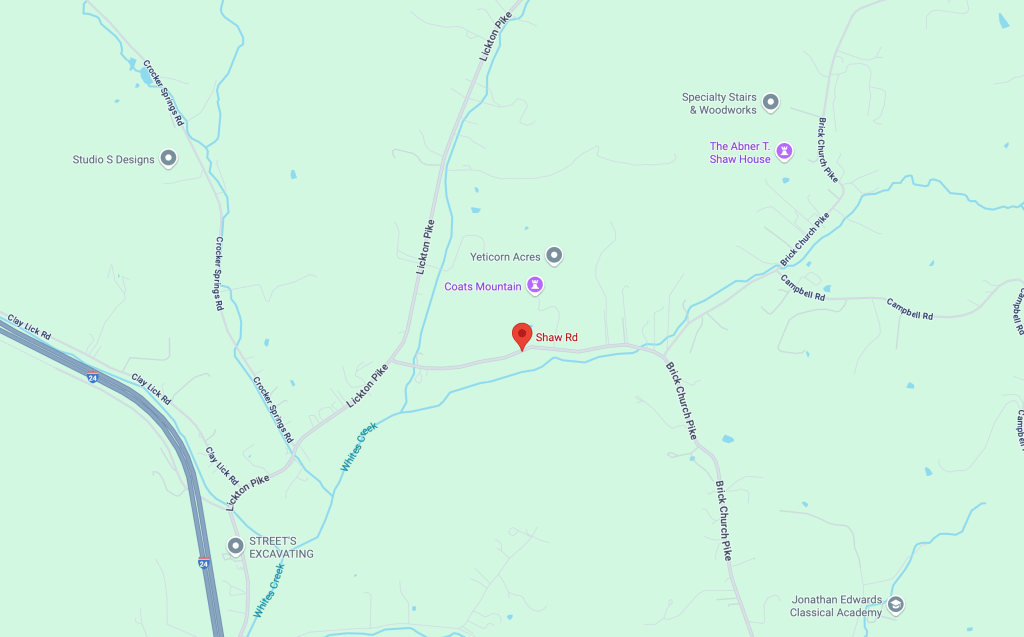
As to where William’s property was located, there are some good clues. Various deeds locate Shaw “on the ridge between Whites and Sycamore creek” and “on the headwaters of Sycamore and Mansker’s creeks.” This places William Shaw’s land just to the west of present-day Goodlettsville. There is a Shaw branch of Whites Creek and a Shaw Road that runs alongside it from the community of Lickton east toward Goodlettsville. That is almost certainly the location of his main tract of land, and later, of some his son Thomas Taylor Shaw’s property.
William’s descendants
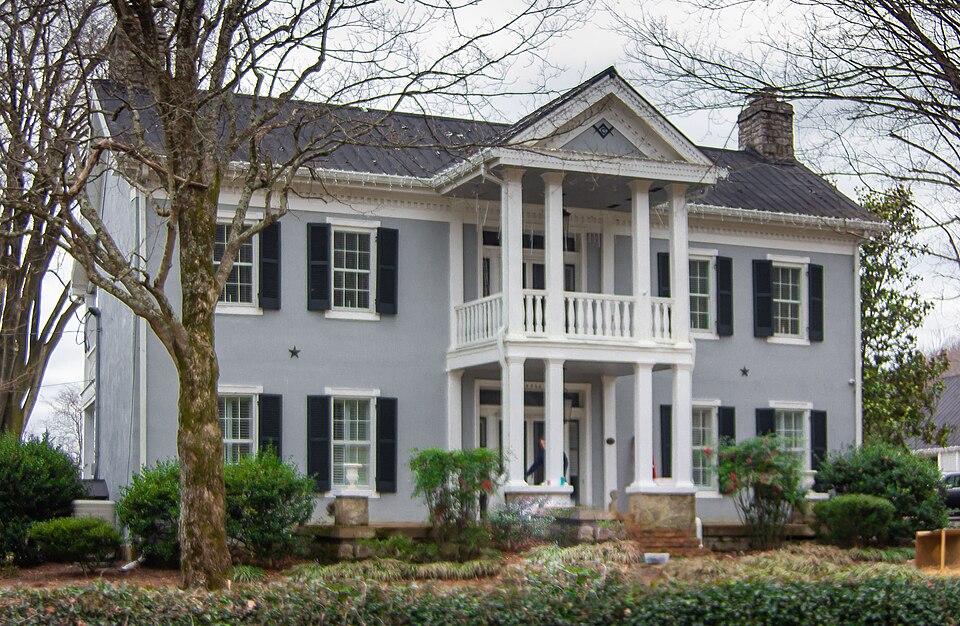
Thomas Taylor Shaw was quite well off. His son, Abner, William’s grandson, built the Abner T Shaw house, a historic antebellum property located on nearby Brick Church Pike just north of Shaw’s branch (see map, above). The house survived the Civil War, supposedly because Shaw and the Union general in the area were both Masons. The Abner T Shaw House is currently being used as a spiritual retreat and is reputed to be haunted!
“Honest Billy” Shaw died in early 1835. His younger son, James Logan Shaw, moved to adjacent Sumner County, and following in his father’s footsteps as a tradesman, was a blacksmith his entire life. His daughter, Jane, also had a trade, as a tailor. Her son, William Jasper Kelly, was a miller. His son, my grandfather, William Bryan Kelly, was a mechanic. His daughter and grandchildren are all mechanically-minded do it yourselfers as well. And so descended the only line of people in my entire family tree that were primarily tradesmen.
I have really enjoyed researching William Shaw, and am looking forward to exploring more of my roots in Southwest Virginia after our move to the area later this year!
 A Long Way to Tennessee
Dear Kelly,
My book “It Is A Goodly Land” by Deborah Kelley Henderson and John Claude Garrett Sr.,Consulting Historian ,has quite a bit of information about the Shaw family you have written
about. It has lots of information about White’s Creek and Goodlettsville.
Deborah Kelley Henderson was a distant cousin to all of us. I still think you could write a book. Really enjoy your ‘A Long Way to Tennessee’!
James Thomas(Tom) Law
LikeLike
I have not heard of this book! I will have to try and find it. And thanks as always for your kind words.
LikeLike
I am interested to know if you are aware of someone named Robert Shaw who loved in what is now White House Tennessee back in the late 1790’s and early 1800’s?
Glenda Clark
purejoy@comcast.net
LikeLike
Hi Glenda. There were several Robert Shaws in Sumner and Robertson county around that time. For a long time, I thought one of them was my ancestor, but that turned out not to be the case! I wrote about him before that, though. Here is the link. https://longwaytotennessee.com/2019/01/22/chunky-bob-shaw-and-the-old-lady/
LikeLike
Kelly.
Thank you so much for your email reply. I really enjoyed reading about the old lady and the chunky Bob Shaw! I am in pursuit of the Robert Shaw because he owned many acres and actually hosted a camp meeting for many hundreds of people on his land and is a part of that history. I will do some searching and see if he was married to that spunky old lady, Elizabeth! Many thanks.
Glenda Clark
LikeLike