
If you have been following this blog, you know that it is VERY unusual for me to be able to trace a line “back to the boat.” Most of my ancestors’ origins are hidden in the mists of the early 18th or even 17th centuries. I can tell from surnames and DNA that my people came primarily from England, Scotland, Ireland and Germany. A few from France, Spain and Italy. At least one person came from southern India, and another from West Africa.
Given my known roots in Virginia, North Carolina and South Carolina, and the Caribbean, a few of my ancestors were likely men of property who came over to claim land grants. Others sold themselves into indentured servitude to the landed gentry for a chance at a new life. I have no doubt that some were prisoners deported as a sentence for petty crimes or participating in political movements. And at least one or two must have been kidnapped and sold into slavery.
I know of several ancestors who came to America primarily for reasons of religious freedom. William Brewster is the best known of these. Like millions of other Americans, I descend from him and other early Puritan settlers. In the late 17th century. My Anabaptist Op Den Graeff (Uptigrove) ancestors arrived in Pennsylvania in order to freely practice their faith. A century later, Caspar Sarver and Barbara Merkj left Switzerland for similar reasons. Their descendants formed part of a minority German-speaking community in Middle Tennessee that persisted throughout the 19th century.
There is nothing particularly unusual about my heritage, especially for an American southerner. I will probably never know the circumstances under which most of my people came to this country. What I do know, however, is that not one single person in the bunch had a visa or a residency permit. Not one. One way or another, they just got on a boat and showed up. And apart from the enslaved and imprisoned among them, they felt they had good reasons for doing so. Poverty, war, oppression, and religious persecution being among them..
Once they arrived, my ancestors did what immigrants have always done. Start at the bottom, take the jobs no one else wanted, work hard, and hope for better options for their kids. Sometimes that journey took a while (and/or was sidetracked by the Civil War), as some of my ancestors lived in dire poverty well into the 19th, and even the 20th century. My own grandparents started out as sharecroppers–but they sent all their kids to college. It’s the American Dream, right?
Our country still needs immigration, full stop. Ask any economist, retailer, or restaurant owner. I volunteer to teach English to immigrants, and you know what they all have in common? Jobs! They are construction workers, fast-food employees, caregivers, and cleaners. They are doing the jobs that more qualified Americans don’t want to do. Some of them don’t have a lot of formal education. But they are learning English, and their kids (who will almost certainly graduate high school, if not college) already speak it fluently. Because that is how it has always worked!
Ideally, in this modern day and age, people would not just show up. Ideally, there would be a highly functional system in place to properly screen and legally incorporate these immigrants. But for several reasons–largely having to do with certain people wanting immigration to remain an inflammatory political issue–we don’t have that system. And the logical consequence of that is that we end up with a lot of undocumented or semi-documented people in our country. Again, doing the work that needs doing. How quickly do you think the housing industry would go bust if all immigrants just disappeared? That’s just one example of the many areas to which immigrant labor is essential to our economy.
Of course, there needs to be some kind of immigration process. But if we want immigration to work in an orderly way, the first step is not to put on “tactical” costumes and go around sweeping up defenseless people and stuffing them into vans. It is to fix the system. Unless, of course, we simply don’t want any immigrants at all. Or only the white ones. And if you can’t see the moral problem with that approach, I direct you to the economic argument, above.
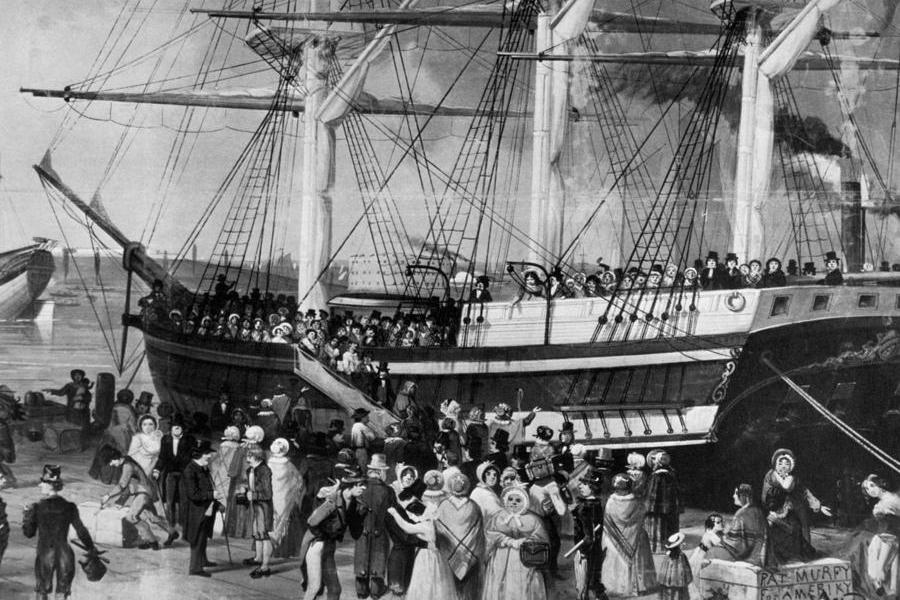
So, as a person who spends a lot of digging into history, I feel very strongly that we would do well to remember that we are (nearly) all descendants of immigrants. That OUR ancestors were once the “huddled masses” of their day. Some of them didn’t even have any choice about coming. But the boats arrived and they poured down the gangplanks into this country. There was no legal process to navigate or overcome. They just showed up and did the work!
It can certainly be argued that the current system of immigration isn’t working. But let’s not forget that we have FAR more in common with the immigrants of today than not. Let’s not forget that our ancestors walked in their shoes. Let’s not forget our humanity and compassion. Let’s not forget that we are, above all else, a nation of immigrants.
 A Long Way to Tennessee
I just wanted to stand up and cheer upon reading this! So on point. So well-stated. Thank you.
LikeLike
So pleased and excited to find this site, I knew I had a Hanmer marriage in my family way back around 1600. Took an Ancestry DNA test some months ago and was getting matches this week from Virginia which I suspected was Hanmer although I had no proof or idea some had ended up in Virginia.
Amazed to find I still have this DNA showing from so far back. I am Welsh (mainly)from the Border area, a family who took the name Williams after the “son of system in Wales”. Owain “Glyndwr’s wife was a daughter of David Hanmer, the Hanmer’s are said to descend from Thomas De Macclesfield, their lands are in Flintshire (Wales). There is the village of Hanmer, their houses were Plas Yr Owredd at Hanmer, Bettisfield, Fenns and Fenns Wood etc:
They were gentry at the court of Henry V111, 2 held the position of Keepers of Black Park “Chirk” and were servants and in laws (as well as an outlaw murderer who was then murdered) to Randall Brereton and William Brereton (who were very powerful in the area). William was executed along with Anne Bolyne. Henry V111’s letters hold some information about positions they held and a case in the Star Chamber concerning Matthew Hanmer, also William Brereton’s confiscated papers (which belong to the Crown as he was convicted as a traitor although probably innocent of that crime.
Rosalind Williams (Great Niece of George “Emlyn Williams” Author, Playwright and Actor).
LikeLiked by 1 person