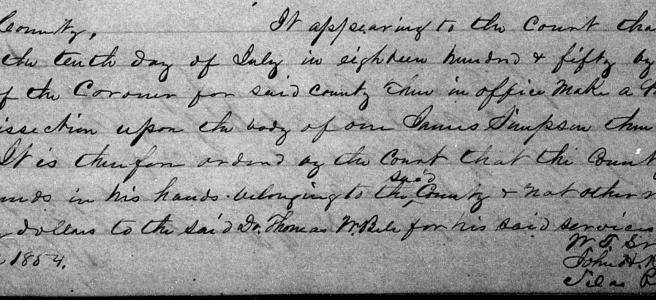
Turning to my 4th great-grandfather, James Simpson (abt 1794-1850), I wasn’t expecting to find anything especially interesting. I thought this would be yet another profile of a hardscrabble southern farmer. But then this popped up:
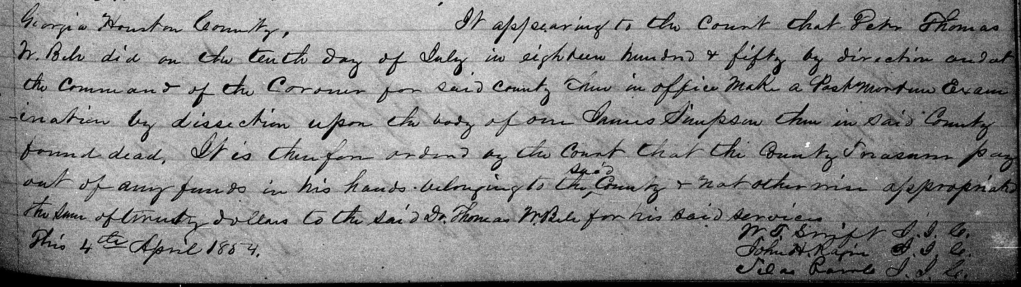
It appearing to the court that Doctor Thomas W. Bale did on the tenth day of July in eighteen hundred & fifty by direction and at the command of the Coroner for said county then in office make a Post Mortem Examination by dissection upon the body of one James Simpson then in said County found dead. It is therefore ordered by the court that the county Treasurer pay out of any funds in his hands belonging to the said county & not other wise misappropriate the sum of twenty dollars to the said Dr Thomas W Bale for his said services.
Wait, what? My ancestor was dissected?
Now, that’s a first in my research. I clearly had to find out more. I quickly discovered another record which (at least somewhat) explained the need for a post-mortem.
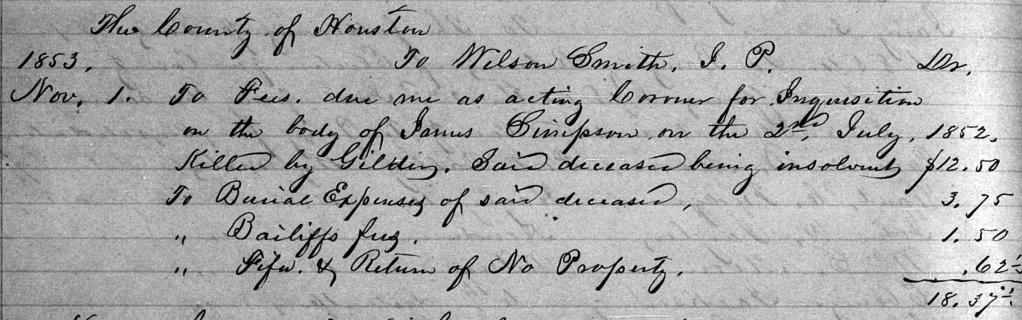
This bill from the county coroner for services rendered states that James was “killed by Gilding.” Again, what? I did a bit of research and discovered that the process of gilding can actually be quite dangerous even today. It involves the inhalation of mercury vapors, which over a prolonged period can cause neurological damage or death. Jeez, the poor guy!
But why, I wondered, was James involved in gilding in the first place? I went back over my records with a fine-tooth comb, and noticed that James did not appear to be a farmer at all. On each census on which occupation was listed, he was recorded as being in “manufacturing or trade.” He owned very little land as far as I can tell. And, his two oldest sons listed themselves as a mechanic and a wheelwright on later censuses, not as farmers.
I think that James was a blacksmith or involved in some other metalworking profession. Perhaps a gunsmith, which could involve gilding fancy weapons. Likely, he was a jack-of-all-trades, as were most blacksmiths of the time. Unfortunately, his experimentation with gilding turned out to be fatal.
The identification as a craftsman rather than a farmer helped tie James to an 1820 census record in Hancock County, Georgia. I had noted this record in the past, but wasn’t sure if it was the same guy. There just weren’t that many people who were not farmers, so this is surely the same person. More court records in Hancock County then popped up. James served as a jury foreman on multiple occasions, indicating he was probably literate. And it must have been this James Simpson who married Lucretia Tucker in Hancock County in 1816. The 1820 census includes a female enslaved person aged 14-25, a hint that Lucretia came from a bit of money, as slaves were often gifted to plantation owners’ daughters upon marriage.
In fact, Lucretia did come from money. James and Lucretia were involved in a lengthy court case in 1817, in which they sued her mother (or possibly stepmother), Polly Tucker, for their one-eighth share of her father, Frederick Tucker’s considerable estate which included a Virginia plantation. Referring to themselves in the testimony as “Your Orator and Oratrix,” they outlined a scheme in which Polly Tucker got herself appointed administrator of the estate in 1806, stripped and sold off all assets, raised a great sum of money and “placed it at Interest at a great amount of profit…combining and confederating with divers other persons as yet to your Orator and Oratorix unknown.”
It appears that James and Lucretia won this suit as it is marked as “settled” and the defendant to pay all costs. Whether they were actually able to recoup the money is unclear. (Quite honestly, I was cheering for Polly just a little. She seems pretty formidable.)
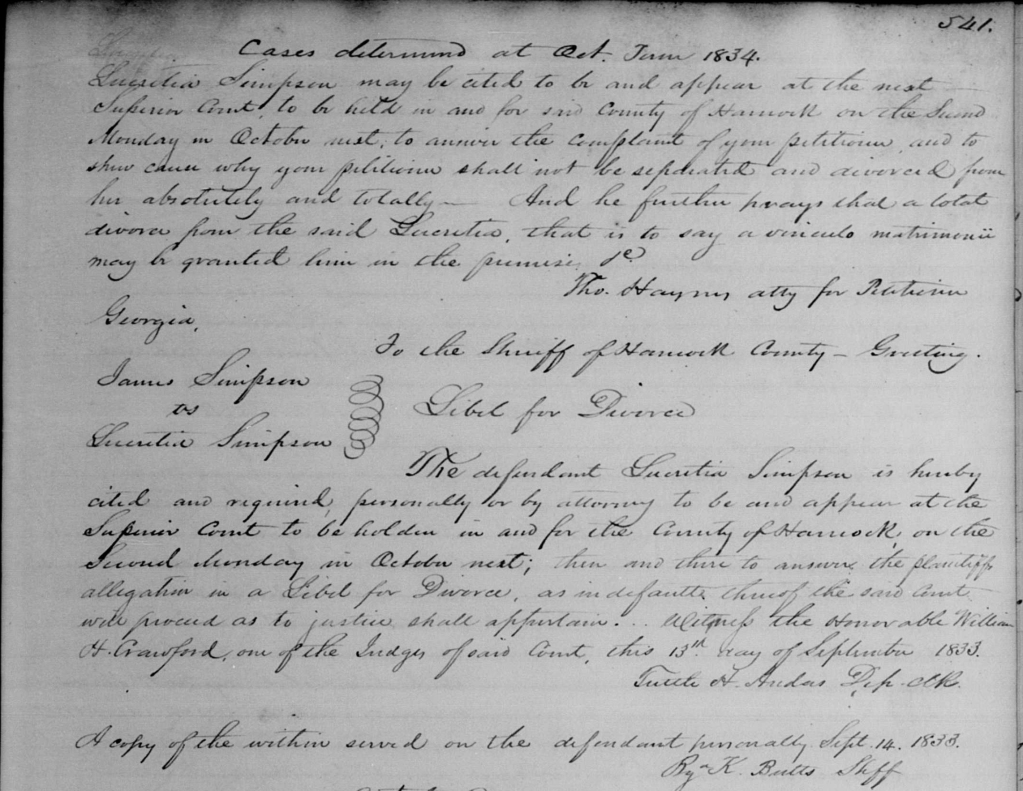
Finally, I unearthed another court case which explained quite a bit about James Simpson’s life. In September 1833, James sued his wife, Lucretia, for divorce, cleaning “abandonment” since 1827. I’m including the full text because it is very personal and interesting. But all is not what it seems! See my comments below.
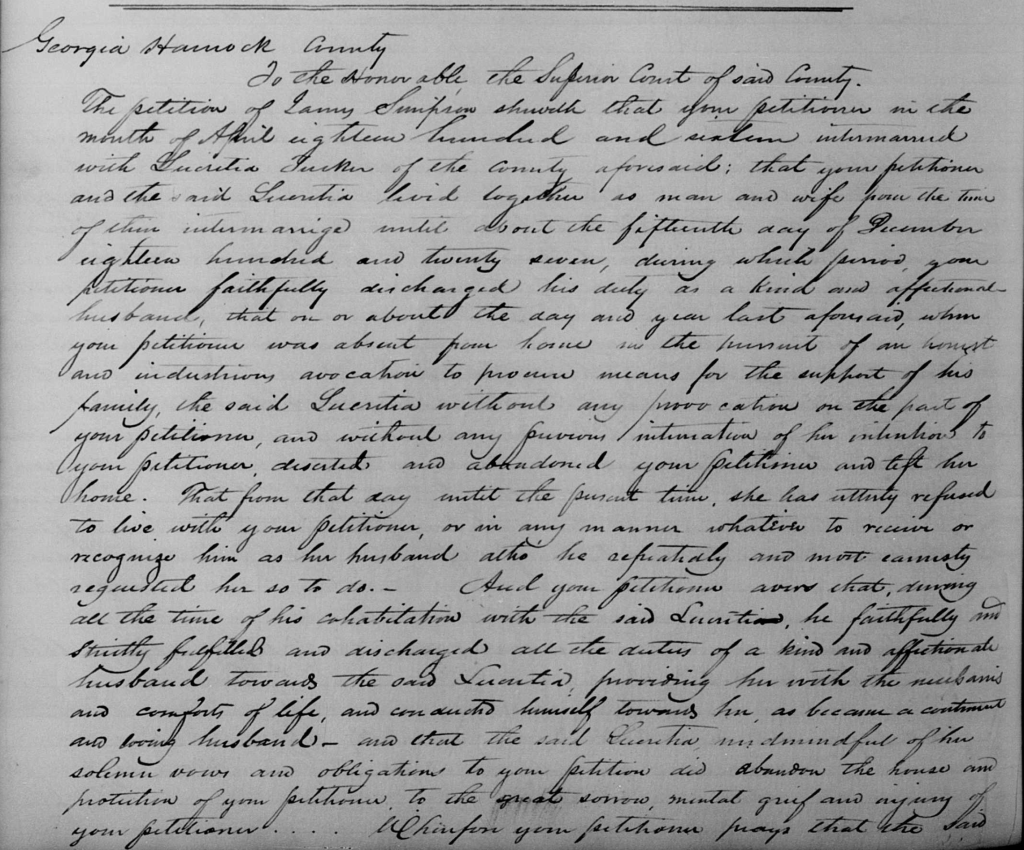
To the Honorable the Superior Court of said County
The petition of James Simpson sheweth that your petitioner in the month of April eighteen hundred and sixteen intermarried with Lucretia Tucker of the county aforesaid; that your petitioner and the said Lucretia lived together as man and wife from the time of the intermarriage until about the fifteenth day of December eighteen hundred and twenty seven, during which period your petitioner faithfully discharged his duty as a kind and affectionate husband, that on or about the day and year last aforesaid, when your petitioner was absent from home in the pursuit of an honest and industrious avocation to provide means for the support of his family, the said Lucretia without any provocation on the part of your petitioner and without any previous intimation of her intention your petitioner, deserted and abandoned your petitioner and left her home. That from that day until the present time, she has utterly refused to live with your petitioner or in any manner whatever to receive or recognize him as her husband although he repeatedly and most earnestly requested her to do so.
And your petitioner avers that during all the time of his cohabitation with the said Lucretia he faithfully and strictly fulfilled and discharged all the duties of a kind and affectionate husband towards the said Lucretia, providing her with the necessaries and comforts of life, and conducted himself towards her as became a continent and loving husband.
And that the said Lucretia unmindful of her solemn vows and obligations to your petitioner and abandon the house and protection of your petitioner to the great sorrow, mental grief and agony of your petitioner.
Wherefore your petitioner prays that the said Lucretia Simpson may be cited to be and appear at the next Superior Court to be held in and for the said County of Hancock on the Second Monday in October next to answer the complaint of your petitioner and show cause why your petitioner shall not be separated and divorced from her absolutely and totally.
And he further prays that a total divorce from the said Lucretia that is to say a vinculo matrimonii may be grated him in the premises.
The Honorable Atty for the Petitioner
To the Sheriff of Hancock County Greeting
The defendant Lucretia Simpson is hereby cited and required to personally or by attorney to be and appear at the Superior Court to be held in and for the county of Hancock on the Second Monday in October next; then and there to answer the plaintiff’s allegation in a Libel for Divorce, as in default thereof the said court will proceed as justice shall appertain. Witness the Honorable William H Crawford, one of the Judges of said Court, this 13th day of September 1833.
A copy of the within served on the defendant personally Sept 14 1833.
The trial appears to have been scheduled for October 1833, then moved to April 1834, then in October 1834 the case was dismissed. I think this is probably because Lucretia had passed away (or possibly remarried) rendering the case moot.
Lucretia and James are found separately on the 1830 census. She is Hancock County with five kids, while he has moved to Houston County–and has a woman and several children living with him! So, who abandoned whom? It certainly looks like Lucretia stayed put as a single mother while James went and set himself up with another woman and kids several counties over.
That woman was Dolly, my 4th great grandmother. Her last name may have been Tilman, but this is based solely on her first son’s name, Tilman. He was born in 1827, by the way, the year that James claimed that his wife “abandoned” him.
Dolly’s only daughter, my 3rd great-grandmother, Sarah Ann Simpson Bembry, was born in 1833, while Lucretia was still living. So, I must conclude that she, and all her older full siblings, were born out of wedlock! In fact, I have never found a record of James and Dolly’s marriage anywhere, so their relationship may never have been legal.
James and Dolly had moved to Sumter County, Georgia by the time of his unfortunate death. Dolly was the farmer in the family, as she stated on the 1850 census. (She is also the person engaged in farming checked off on the 1830 and 1840 censuses.) In fact, given I have almost no record of James purchasing land, she may have brought land into the family. If they never actually married, it would have remained legally hers. On the 1852 tax list she has 330 acres of mostly pine land. By 1860, this had been reduced to 40 acres. And by the time of the Civil War, with nearly all her nine sons either at war, or already killed, the family had been reduced to dire poverty, as an earlier court records discovery illustrated. Dolly passed away some time between 1864 and 1870.
So, when I started researching James Simpson, I thought there would not be much to see. In fact there was quite a lot! However, I still do not know who his parents were, or where he came from. He may be the James Simpson from South Carolina who served in the War of 1812. His many children stated his birthplace as being North Carolina, South Carolina, Virginia, or Georgia, depending on the census (to be fair, they didn’t know him very well).
In 1820, James Simpson is the only Simpson in all of Hancock County, so no joy there. An 1830 deed from Houston County may provide a hint: James, Arthur and Thomas Simpson jointly purchased land from a Euphemia Simpson, who was probably a relative, maybe their mother. And a Thomas and George Simpson appear in earlier Hancock County court records. But that’s all I have for now on the surprising (and slightly sketchy) James Simpson.
 A Long Way to Tennessee