In a break from doomscrolling lately, I’ve been picking ancestors at random and searching for them on Family Search’s new full text search feature just to see what pops up.
Most (nearly all) of my ancestors were subsistence farmers who didn’t leave much of an impression on the historical record even with a “deep search.” But, with Daniel T Sumner, my paternal 3rd great grandfather, I got lucky. There were multiple mentions of Daniel across court, probate and real estate records that I had not known about before.
The Sumners were relatively educated and middle class for the times. Daniel’s father, John Chessnut (or Chesstnut) Sumner, was a Justice of the Peace in Emanuel County, Georgia. He owned a fair amount of land as well, with over 1,400 acres at the time of his death. Daniel was educated like his father,, signing his own name to documents and serving as a Grand Juror as a young man
This line of my dad’s side is the one he describes as a “bunch of preachers” and in fact, there were quite a few preachers and churchgoers among the Sumners and Smiths. I learned from these records that this staunch Methodism must have originated with Daniel’s wife, Delilah Key (or Kea), daughter of the Reverend Warren William Key. Because Daniel Sumner was apparently not so very Methodist.
In 1856, Daniel posted a bond along with his brother Robert Sumner for a man named Standley Meeks for his license to “Retail Spirituous Liquors.” Meeks was required by the bond to keep an “orderly and decent house,” and if not, then Daniel and Robert would be entitled to get their money back.

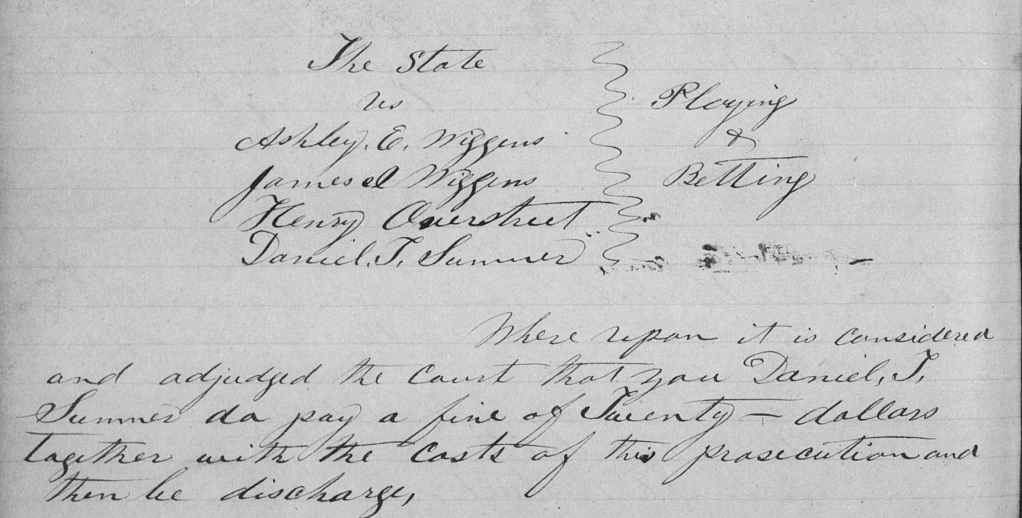
A year later, in 1857, Daniel was fined $25 for “playing and betting,” likely in the same tavern that he had helped open with his bond. Honestly, I’m glad at least one of my ancestors knew how to have a good time!
1858 was a tough year for Daniel. Court records show that, in March of that year, together with a cousin, Alexander C Sumner, he was sued by Benjamin Burch for $970 in bad debt. Apparently, he and Alexander borrowed $900 from Burch in 1855 and promised to pay it back in 30 days. (This sounds like it may have involved land speculation.) According to Burch, both Sumners claimed that the promissory note had been lost and refused to pay. The court accepted a copy of the note from Burch, and required that the two men repay $530.37 in debt and another $93.93 in costs. Perhaps in an effort to pay the debt, Daniel sold 300 acres of his land for $225 in August, 1858.
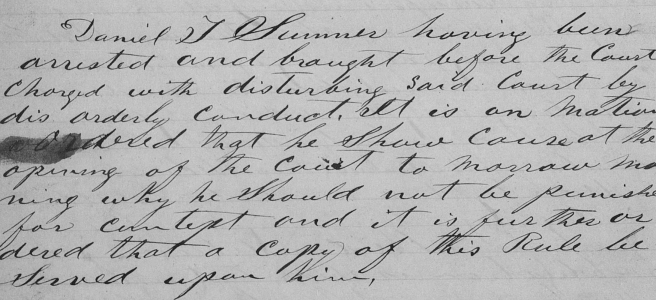
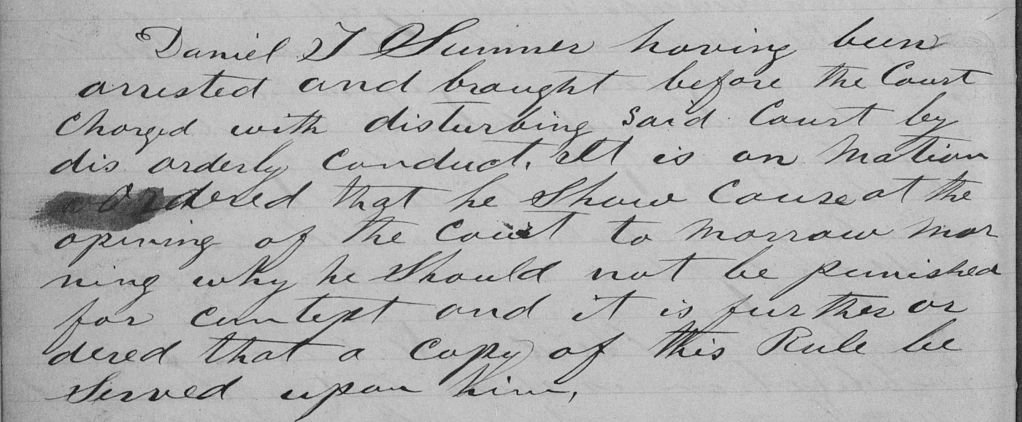
By September 1858, Daniel was hitting the wall. He was arrested and charged with disorderly conduct and contempt of court! But he may have had his reasons. Later newspaper clippings show that in addition to the lawsuit with Daniel, Alexander was involved in at five other similar and concurrent lawsuits, losing them all. It certainly sounds like at minimum Alexander Sumner had some sort of business plan that went off the rails, if it wasn’t an outright scam.
In 1860, a 1,450 acre tract belonging to Daniel was seized and auctioned off to pay off the debt from the lawsuit. This would have been financially devastating. However, Daniel apparently had some other funds resulting from the settlement of his both his father’s and father in law’s estates at around that same time. Just two months after the court-ordered auction, he moved across the county line to Ware County, and made a fresh start with an $800, 450-acre tract in or near Waresboro purchased from Jacob Taylor. At some point between 1862 and 1865, he is found on tax lists with 1255 acres and one enslaved man valued at $1200 (this is the only instance I have found of Daniel holding slaves.)
The ups and downs of Daniels’ life continued. In 1865, of course he would have lost the enslaved man that he had recently acquired. It does not appear that his new farm did very well either, as he sold the same tract of land back to James Taylor (likely Jacob’s son) for $1,000, at least making a small profit.
The family is not found at all on the 1870 census for some reason. But on an 1875 tax list, they are found in Waycross, with land valued at just $317. Daniel qualified for a tax exemption, presumably based on a homestead statute of some kind. His property is listed in the schedule and is pretty minimal: one house, six hogs, one cow and calf, 2 plows and other farming utensils, five arms, household and kitchen furniture, and wearing apparel. (I mean, I guess it’s good that the two adults had five guns between them?)

In June 1880, Daniel is found in Columbia County, Florida, with a new (much younger) wife, Elizabeth and three stepchildren, On this census, he calls himself a blacksmith as well as a farmer.
In an odd twist, his first wife, Delilah, is listed in a separate household, that of their son, Jordan. But she is crossed out and noted as “dead.” My guess is that she passed away late in 1879, and Daniel remarried about ten minutes later, on 6 November 1879. But it is still very strange that Delilah was listed at all on the census, as she would have had to have died at least six months earlier.

It is worth noting that Daniel and Delilah had one last child after the 1860 census, as evidenced by the 1875 tax entry. Since the family is not found on the 1870 census, and the 1875 record does not name family members, it is impossible to know the name of that youngest child. But he or she is not found in Daniel’s household in 1880. So, it is possible that Delilah simply left without bothering to get a divorce, and is living with that child in 1880. But I have not been able to locate either of them to date.
Daniel died some time after 1880 and is likely buried in Columbia County, Florida, though I have not been able to find any record of his burial or Delilah’s. At least he did leave a somewhat interesting paper trail! His granddaughter, Mollie Sumner Smith, was my great-grandmother. I’ve always heard that she was a crack shot. Maybe she inherited this ability (and possible a shotgun) from her well-armed, drinking, gambling, disorderly grandfather, Daniel.

 A Long Way to Tennessee
Hi! Just wondering if you have any proof that John C. Sumner is Danuel T. Sumner’s father. We are related and have corresponded before. You added me for access to your tree on Ancestry.com but I don’t have a membership any longer. I’m still trying to prove the relationship. Thanks!
Marilyn Sumner Westendorf
LikeLike
Hi Marilyn. The best evidence for Daniel T Sumner being John C Sumner’s son is a newspaper snippet in which he applies for “letters of administration” for John’s estate. This is dated 26 Nov 1858 in the Central Georgian newspaper. The next year, Robert Sumner did the same, so for some reason, Daniel wasn’t able to fulfill the administrator duties. But typically, an administrator would be the son of the deceased.
LikeLike
Thanks Kelly!
Sent from AOL on Android
LikeLike