In my first post profiling William Shaw, I annotated his testimony from his Revolutionary pension application. Now I’ll move on to the second part of his application, which contains testimonials from witnesses as to his character and the veracity of his claims to service.
William’s friend Robert Weakley offered the first of several testimonials.
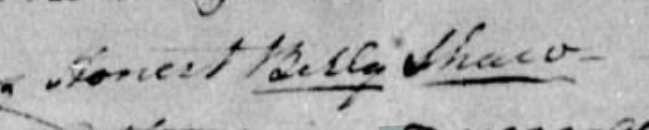
On this first day of August 1832 personally appeared in open Court before the Justice of the Court now sitting Robert Weakley a resident of said County and state aged 68 years — who first being sworn according to law doth on his oath make the following statement, that he has been acquainted with William Shaw of Davidson County who is the applicant under the law of Congress passes June 7th 1832 ever since the latter part of the year 1785 & that he Shaw has ever during his acquaintance been considered an honest man & man of truth and is bound to believe his statement as to the service rendered during the American Revolution to be true—as I was in the Battle by spoken at Whitesell’s Mill in March 1781—and from the statement of Shaw I am satisfied he was there, he Shaw is called by acquaintances Honest Billy Shaw.
Well, this is fun, to know that William Shaw’s nickname was “Honest Billy!”
The Battle of Whitesell’s Mill, more commonly known as the Battle of Wetzell’s Mill, took place in March of 1781, while William was, as he stated in his own testimony, stationed in Guilford County, North Carolina. It was not a particularly important battle, but is interesting for the characters involved which are well known: Major General Nathaniel Greene, commander of the Continental Army, Major Harry “Light Horse” Lee, and on the British side, Lt. Col. Banastre Tarleton, who some may know as a character from the Outlander novels. William Shaw was truly a witness to history!
A year after his original application, on September 3, 1833, William returned to court. Evidently, the lack of a paper trail for his service was an obstacle to his receiving the pension. He swore once again that “to the best of his recollection” his testimony was accurate. (He refers to the “infirmities of a mind worn with age” but in fact he seems quite on top of things.)
On the 3rd day of September 1833 personally appeared the aforesaid Wm Shaw… and made oath to the following (amended) declaration in order to obtain the benefit of the provisions made by the Act of Congress passed on the 7th June 1832 to wit: the applicant states that to the best of his recollection he served in all throughout the different tours reference to his original application not less than Ten months. He has reviewed the time with the accuracy that the infirmities of a mind worn with age could command and he is confident that he is, if anything, under the time of his actual service. By reason of old age & consequent loss of memory he cannot swear positively to the precise length of his service but according to the best of his recollection he did not serve less than the period of Ten months aforesaid being five tours of two months each and also the time in the capacity of a Private Soldier in his original application.
Another problem with the application appears to have been the lack of a clergyman to testify to William’s character. Apparently, he was not a churchgoer. However, he shrewdly made sure the court knew that there were bigger guns on deck just in case, including the county Justice of the Peace, the State Treasurer, Senator Felix Grundy, and even the Governor of Tennessee, William Carroll!
Applicant further states that he has not obtained the evidence of any clergyman… because he knows of no clergyman who can give the certificate as required by the Department. He has endeavored to verify supply the deficiency of such evidence by the testimony of other respectable witnesses. Applicant further makes oath…that he never received any discharge from any officer whatever for any tour of service. He does not know why it was that no such paper was furnished by his officers but he is confident none was ever given to him. Applicant further states that he is well known to Robert Weakley, Thos Crutcher, State Treasurer, E P Connell, James Channing, Isaac Hunter & Robert Payne Esq acting Justice of the Peace for Davidson County with the Honorable Felix Grundy, Governor Carroll, Ephraim Preston and a large circle of respectable friends throughout the County.
I have no evidence that William Shaw was a terribly wealthy man. He was, however, one of the earlier settlers of Davidson County, making his home on White’s Creek just north of Nashville by 1785, and a merchant as well as a farmer. This would have put him in contact with many members of the “first families” of the area, so it is possible that he really could have produced all these character witnesses. (I have more information on William’s life on the outskirts of Nashville which I will relate in my next post.)
Two days later, on September 5, 1833, it appears that William was able to scare up a clergyman after all. An old friend, David Cloyd, stepped up. It’s worth noting that William was found in “Captain Cloyd’s district” on the 1811 tax list for Davidson County, so Cloyd was surely a neighbor who had known him for decades–and was willing to overlook his lack of religiosity.
Came in to the court David Cloyd a clergyman residing in the County of Davidson and made oath that he has been well acquainted with the above named applicant for thirty years or more. Most of the time he has been a near neighbor of affiant. Affiant states that he does not know anything of the revolutionary services of said Shaw except from his own repeated declarations. The said Shaw has always sustained an irreproachable character for honesty, truth and integrity and affiant would not hesitate to place the most unqualified faith in any declaration he would make on oath of otherwise.
The wheels of bureaucracy have always turned slowly! Finally, in March of 1834, William Shaw’s application was approved.
And the Court aforesaid does hereby declare an opinion after the investigation of thjs matter that the above named applicant Wm Shaw was a revolutionary soldier + served as he states. And the court further certifies that it appears that David Cloyd who signed one of the preceding certificates is a clergyman resident in Davidson County and that Robert Weakley + John McCaslin who also signed the certificate above are residents of said County. That they are credible persons + that their statements are entitled to credit.
William was granted a pension of $33.33 per year, back-dated to September of 1831. That would be $1,245.86 today, with a an additional lump sum payment of $3,113.72. Certainly enough to help make William more comfortable in his final years. He was not able to collect it for very long, though, as his estate went through probate in August of 1835, indicating that he passed away shortly before then.
I am glad that “Honest Billy” lived long enough to record this first-hand story of his military service. Such a document has been extremely rare in my research. It means that 250 years after William roamed the mountains of Southwest Virginia as teenage patriot, I can share his story on the internet.

 A Long Way to Tennessee