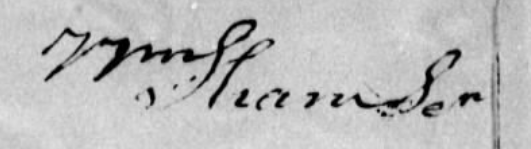
I’ve recently rolled back around to researching my 4th great-grandfather, William Shaw. He applied for a Revolutionary War pension in 1832. and testified in court to the details of his service. Transcribing his testimony has revealed a wealth of information! In this first of two posts, I will focus primarily on his military career.
After my experience spending a good deal of time researching the wrong William Shaw, you can bet that my first question was, is this the right guy? And yes, I am pleased (and relieved) to say, the witnesses interviewed for the pension match up with my William’s neighbors on tax lists and in deeds. This William Shaw is definitely my ancestor.
Here are excerpts from William’s testimony, with annotations.
On the first day of August 1832 personally appeared in open Court before the Justice of the Court Moore (Mason?) William Shaw a Resident of said County and state aged seventy one years last April, who being first duly sworn according to law, doth on his Oath make the following declaration in order to obtain the benefit of the Act of Congress passed June 7th 1832…that he was born in the state of Virginia in the year 1761 in the month of April as believes from his Father’s register in the family Bible, and was raised to Manhood principally in what is now Wythe County on the waters of the New River…
Well, this is great! Now I know where William was born and when, down to the month. I have been researching these origins and will have more to say about them in my next post. Stay tuned.
…that in the year 1776 the Cherokee became troublesome, and that he William Shaw volunteered under Captain David Snodgrass to guard his Snodgrass’ station near where Abingdon is now situate in Washington County and remained in service about two months…
Note that his birth year of 1761 means William Shaw was no more than fifteen years old at the time of his enlistment!
I was not able to find a “Captain David Snodgrass” from southwest Virginia. That doesn’t mean that there wasn’t one, it just means that if there was, he didn’t make much of an impression and isn’t showing up in online sources. However, Abingdon, Virginia was the site of a fort established to protect the inhabitants of the immediate area. The fort however, was built by Joseph Black, and was known as Black’s Fort, not Snodgrass’ station. Either William (or the court clerk) simply got the name of the fort wrong, or perhaps there was some minor local captain and smaller fort involved that are now lost to history.
William Shaw was accurate in his recollection that 1776 was the year that the Cherokee became “troublesome.” At that point, the local Cherokee, led by chief Dragging Canoe, formed an alliance with the British, hoping to push out the colonists, who were in fact, squatting on Cherokee land. The resulting short-lived, and largely forgotten conflict is now called the Cherokee War.
…some time after volunteered under Col William Campbell (after wards Gov Campbell) against the Cherokee and went as far as the long Island of Holston an entire frontier, remained in service two or three months that was some time after the Battle with the Indians at the long Island of Holston.…
Colonel William Campbell was a real character. According to the Journal of the American Revolution, he “resembled a Scottish clan leader straight from a Sir Walter Scott novel, even carrying his Scottish father’s broadsword.” Campbell was a soldier in the Continental Army who requested to be released from service in order to defend his native Southwest Virginia from Tory and Indian raids. It must have been during this time period that William accompanied him as far as “the Long Island of Holston” near Kingsport (Sullvan County), Tennessee.
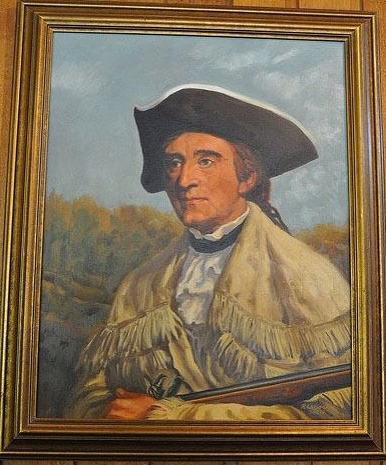
The Long Island on the Holston River was originally a sacred place to the Cherokee. Unfortunately for them, it also was a desirable location for white people moving west. Daniel Boone routed his Great Wilderness Road through the Long Island, for example. This was no doubt the reason for Campbell’s expedition to the island; as the Cherokee were allied with the British, the colonists would have considered it to be fair game.

This Colonel William Campbell never became governor of either Virginia or Tennessee, because he died suddenly in 1781. He was, however, elected to the Virginia state assembly, and that may have been the source of confusion.
I next volunteered under Col William Campbell at New River in pursuit of Koyle & Brown two Tory Captains who had raised a Number of men & was Commiting depredations on the Whigs. we came up with them and dispersed them wounded one Man & took him and a Nother prisoner and run the ballance over the mountains into the Hollows of the Yadkin…
Southwest Virginia was a hotbed of Tory activity at the time, which was of great concern to the colonial government due to the iron and lead mines located in the New River Valley. James Coyle and John Brown were two “notorious Tory plunderers” who ran roughshod over local Whig settlers. I do not think that William Shaw’s company captured these two men, as they were captured later by a Captain Robert Cleveland of the North Carolina militia. But William’s account of “Koyle” and Brown’s “depredations on the Whigs” is true and it makes perfect sense that Campbell and his men would have been dispatched in pursuit of them and done some damage, even if they did not actually capture Coyle and Brown.
…I was then in service about two months in 1780. I volunteered with Captain Trigg under the Command of Col William Campbell went over the mountains into the state of North Carolina, was stationed some time at the Moravian town, we were informed that a Number of tories was Collecting below Guilford Old Court House, Captain Trigg with his Company of whom I was one, was ordered by Col Campbell to go in pursuit of the tories. we came on them took upwards of twenty of them prisoners & drove them to head quarters to Col Campbell at the Moravian town. then some of them were Whip’d and Hung…
Colonel William Campbell did indeed pursue Tories into North Carolina and per one contemporary account, “Our People shot one, Hanged one, and whipt several, and next Monday are to have a Sale of the Tories Estates.” (The “Moravian Town” is now Salem, North Carolina.) There were several Captain Triggs from Virginia. I think William’s captain was probably Captain Daniel Trigg who served under Campbell, but as documentation from that time is a bit informal, I am not 100 percent sure of that.
..then returned over the mountain back to New River & scoured the Country down said river of tories running & dispersing them as low down sd River as peppin’s ferry. was in service two or three months at that time…
After dispensing frontier justice, Campbell would then, of course, have returned to his native Virginia. “Pepper’s ferry” was a crossing on the New River near Christiansburg in Montgomery County, north of William’s home territory in present-day Wythe County. So this would have been at least a 150-mile march between Salem and Christiansburg.
I then volunteered with Col John Stephens with about sixty men to Guard the flowery Gap to prevent the British & tories from Crossing Over to the lead Mines on New River, the Brittish Army then lay at the Moravian town…
Flower Gap, then known as “flour gap” or “floury gap” was located on a spur of the Great Wagon Road on the North Carolina/Virginia border. It was originally named for the mule trains that carried flour through the gap from the Yadkin River valley flour mills. William’s company was in charge of keeping the British, who then occupied Salem, from traveling that road to get the lead mines in Southwest Virginia.
…in February 1781 – volunteered with Colonel Preston & Cloyd & went to General Greene his Army in North Carolina near Guilford & remained until the Battle at Guilford Court House…

“Cloyd” was almost certainly Major Joseph Cloyd of Montgomery County, VA, which adjoins Wythe County. He is best known for the Battle of Shallow Ford, however, this battle took place in 1780, before William Shaw joined that regiment. “Colonel Preston” was William Preston, a wealthy “planter” (and slaveholder, of course) from Montgomery County who commanded the Montgomery County Militia at the Battle of Guilford Court House, a pivotal event in the Revolutionary War and in American history. (I have actually visited William Preston’s plantation in Blacksburg, so it’s kind of fun to know that my ancestor fought in his regiment, and especially at Guilford Court House!)
…during the whole of my Service I found my own Horse to ride & my rifle and shot Bagg – for which I never received any Consideration except one Indian pendant which I Glory in…
This would have been a typical experience for a frontier militiaman. They were expected to come equipped, and supply their own horse. Militias were more informal than “minutemen” or regular troops. However, they were well-suited for guerrilla warfare on the frontier, as you might imagine.

In 1781, William Shaw turned twenty, so all of his Revolutionary war service occurred before he was even a legal adult!
I have lived in Davidson County upwards of forty-six years help to defend this Country from the Indians from that time was with General Jackson in the Creek Nations volunteered...
The Creek Wars were super complicated. The shortest possible version is that they were a civil war between Native nations as much as anything else, but whites on the frontier were worried about the conflict and got mixed up in it. Governor Blount of Tennessee raised a force of 2,500 West Tennessee volunteers (this included Davidson county at that time) to “repel an approaching invasion … and to afford aid and relief to … Mississippi Territory.” General Andrew Jackson then marched and murdered his way down through a swathe of Mississippi until the Battle of Horseshoe Bend ended the conflict.
Apparently, the terms of enlistment were for just 60 days at a time, so I do not know what actions William may have participated in. But given that his other stories all check out, I assume that he did enlist for a short time, even though he would have been around 50 years old at the time. It is also possible given that he only states that was “in the Creek nations” that he was along on some earlier mission with Jackson, when he would have been younger.
I never was intent on a pension nor never apply before I have no way of proving the above service that I now know off except by my own Oath as I believe most of my Companions in Army are dead or removed that I known no where to find them.
Sworn and subscribed the day and year afore sd
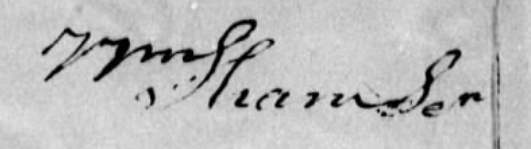
William Shaw Sen.
Well, how cool was that? I really enjoyed researching William Shaw’s military service, and feel like I learned a lot along the way!
In my next post I will review what the rest of the pension application, as well as some court records I have dug up, reveal about William’s personality, his background, and his friends and neighbors.
 A Long Way to Tennessee