After wrapping up my investigation into James Kelly’s father, Edward Kelly, I decided to move on to his presumed father-in-law, Boston Martin.
Is Boston my 4th or 5th great-grandfather?
A few years ago, I investigated James’ wife, Matilda Martin, and concluded that Boston Martin was most likely her father. However, there have always been some issues with that theory, chiefly that Boston does not have two girls the correct age to be Matilda and her sister Eliza in his household in 1820 and 1830. He does have two younger girls, however, which could be a mistake by the census-taker (perhaps the girls were petite and looked younger than their ages?)
I believe that Boston was certainly Matilda’s guardian, as evidenced by the arrangements made with James Kelly in 1832 in which he left all his property to James in return for lifetime support. However, rather than being her father, he may have been her grandfather. My most recent research has shown that Boston was born no later than 1761, which means he was in his early fifties when Matilda and Eliza were born. His wife, Mary, while a bit younger, was no spring chicken either. It’s not impossible they were the girls’ parents, but it seems rather unlikely. I hoped to figure out who their likely father might be.
This research is greatly complicated by the lack of an 1790, 1800 or 1810 census for Sumner County! However, the 1820 census shows that Boston had three young men in his household at that time, one aged 26-44 and two aged 16-25.
I was able to positively identify the older son from 1820. William Martin, born about 1792, is found right next door to Boston on tax lists and the 1830 census. And William had a son named George, who had a son named Boston! The name is so unusual for that place and time that I am comfortable saying that is proof of the relationship. In fact, William is just barely old enough to possibly be Matilda and Eliza’s father, though there is no record of him being married before 1825.
I do not know who the two younger sons on the 1820 census might be. There is a Peyton Martin who shows up near Boston just once, on the 1822, tax list who could be a candidate, and there is also an extra George floating around who fits the description (there are a lot of George Martins, as we shall see!)
There is one more possibility, a Jeremiah Martin who does not show up on any tax list or census. Boston witnessed a deed for him in 1812 and that is the only time he shows up in court records. As he was old enough to buy land at that time, he could potentially be the father of Matilda (b. 1807) and Eliza (b. 1806). Sure would be nice if there was a 1790 or 1800 census to help confirm this theory!
One more possibility is that Matilda and Eliza were born out of wedlock to a daughter of Boston Martin then raised by home and his wife. Again, without. the 1790-1810 censuses, it is very difficult to pursue that theory further. So, with no evidence to the contrary thus far, I’ve settled on placing them as Boston and Mary’s late-in-life daughters.
Where did Boston come from?
The general assumption has been that Boston Martin came from North Carolina. However, the great thing about identifying William, who was born about 1790, is that he lived long enough to list his birthplace on the 1850 and 1860 censuses. In 1850, he stated North Carolina, however, that census entry included several errors. In 1860, he clearly stated that he was born in Virginia.
AHA! I thought, let’s roll the dice and run a full-text search on Family Search for “Boston Martin” in Virginia!
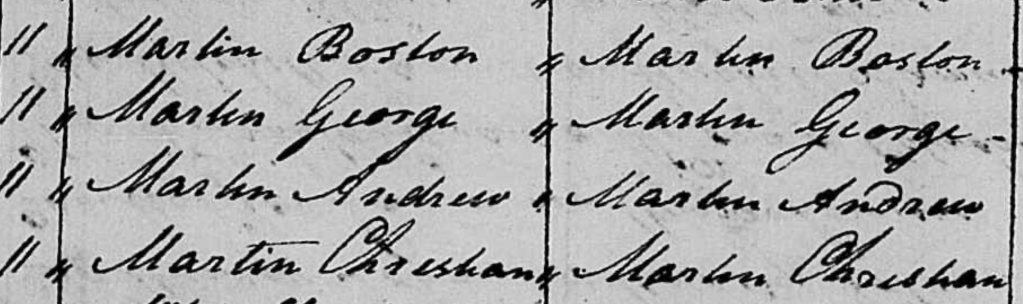
The first item to pop up was a 1787 tax list from Captain Smith’s Company in Montgomery County, Virginia, listing Boston Martin along with George, Andrew and Christian Martin. Given that Boston is such an unusual name, I felt certain this was the right guy. More digging proved me right. A rather exhaustive (there were spreadsheets!) study of tax lists from Montgomery County, Virginia and Sumner County, Tennessee clearly showed that a small flock of related Martins moved from Virginia to Tennessee around 1790.
Boston Martin was very likely one of the youngest sons of a George Martin who is found in Botetourt County, Virginia by 1772. Part of Botetourt became Fincastle County in 1772, and part of Fincastle became Montgomery in 1776. Records of this Martin family are therefore found under all three counties, however, they are the same family and did not actually move during this time period.
George Martin I is found on a 1774 list of Fincastle County militia called up for Lord Dunmore’s War, a conflict between white colonial settlers and Native American tribes. He, or his son, George, served on the Fincastle County Committee of Safety in 1775-1776, an early form of shadow government in protest of British rule. George had another presumed son, Christian,”Christy” Martin, who served in the militia as well, along with a Phillip Martin who may be yet another son.
Another possible son, Andrew, is found next to George I on the 1772 tax list. He could also be a George’s brother or father, there is no way to tell at the moment. He is not the same Andrew who appears in later records. These Martins loved to live near each other and repeat names in every generation which can be very tricky.
Once Boston Martin pops up in the records, he is found in the same small Montgomery County tax district as these other men from 1782-1790, living between Andrew and Christian Martin in 1790.
George Martin II, Boston’s presumed older brother, moved to Sumner County, Tennessee by 1787. Boston and the first Andrew moved in 1790: in fact, they are found on a tax list in Montgomery VA in February 1790, and then later that same year in Sumner County. Andrew, who also lived very close to Boston in Sumner, left a will in 1809, naming all his many children. This was super helpful in determining that 1.) Andrew was not Boston’s father and 2.) which Martins in that Sumner County district were not Boston’s kids!
What I know about Boston’s life
Deeds place Boston “on the west middle fork of the Red River” which would be just northwest of Gallatin. I know that he lived near George Martin II, who had land on Drake’s Creek. As far as I can tell, this would place both men in the same area as later generations of Kellys, in District 18, near present-day Cottontown, Tennessee.
Boston was not a wealthy man and left very little in the way of court or real estate records. He did not own any slaves. He appears to have been literate enough to sign his own name. I assume he was a farmer, because almost everyone in the area was, but with only 150 acres of land and living right on the Red River, it is possible he was a miller, as were later generations of Kellys.
There are a couple of interesting notes in court records that could lead to more information later. In 1814, Boston served as “next friend,” or representative, for a neighbor, Mary Fleming in a divorce case. Her husband, Alexander Fleming had apparently abandoned her and “took up with” Keziah Biggs. And in 1829-1830 Boston was appointed “agent” for Sarah Smothers to manage her support funds under the county poor law. Both of these women may well have been relatives.
A fun postscript
Jumping back for a moment to Virginia. George Martin I’s land was on Sinking Creek, a branch of the New River just north of present-day Blacksburg (then known as Hans Meadows). Remember that his presumed sons were Christian, Andrew and Boston. Christian was definitely the oldest son of these three, and may in fact have been a younger brother to George I. But I am going with him being George’s son for the moment.
Christian Martin stayed in Montgomery County, Virginia, leaving a will in 1809 and passing away shortly thereafter. Deeds show that he also owned land located between Sinking Creek (probably inherited from his father) and Tom’s Creek. In fact, Christian was named as original surveyor for the road from Blacksburg to Tom’s Creek in 1780.
I am familiar with that road and neighborhood, as one of my children lives very nearby. In fact, we plan to retire to the area very soon. Maybe there is a reason those Blue Ridge mountains have always called to me?
 A Long Way to Tennessee